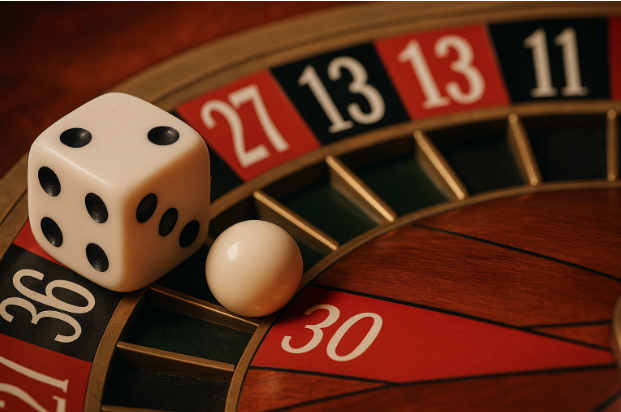
Roulette is simple on paper: a wheel spins, a ball lands, wins get paid, losses get swept. But inside the mind of the player, the experience is anything but simple. Certain outcomes stick, others vanish, and many decisions are shaped by biases we don’t consciously notice.
Understanding these psychological patterns doesn’t change the odds—but it changes how the game feels, and that difference is often what separates controlled play from emotional play.
Below is a breakdown of the cognitive traps that shape roulette decisions, why the brain stores some spins more vividly than others, and what practical lessons players can apply instantly.
1. Why Near-Wins Hit Harder Than Actual Wins
A “near-win” in roulette is anything that feels close:
- the ball bouncing out of your section
- a neighbor hit
- missing your inside number by one pocket
- the wheel showing your last two numbers but not yours
Even though these outcomes have no mathematical relevance, they create a strong reward-like response in the brain.
The reason: mistaken reinforcement
Near-wins trigger neural activity in many of the same reward circuits used for actual wins—especially in the striatum and the anterior insula. Your brain interprets “almost” as “you’re on the right track,” even when you’re not.
The effect is powerful because the emotion is ambiguous: you didn’t win, but it felt like progress.
Practical takeaway
When a near-win makes you think, “Okay, one more spin, I’m close,” remind yourself of something brutally simple: roulette doesn’t track progress. A near-win is just a spin you lost—but your brain doesn’t frame it that way.
2. Why Big Losses Fade From Memory Much Faster Than They Should
Humans aren’t built to hold onto financial pain with accuracy. We’re built to distance ourselves from it.
The brain protects itself
When you lose big—one bad session, one tilt moment, one big straight-up push—the emotional discomfort is immediately filed away into a mental drawer marked “unpleasant.”
Your brain actively minimizes these memories through:
- avoidance (not thinking about it)
- distortion (remembering the loss as smaller than it was)
- justification (“I would’ve won it back if I played longer”)
This isn’t a gambling-specific flaw; it’s an everyday human defense mechanism.
Why this matters in roulette
Loss amnesia increases the likelihood of repeating the exact pattern that caused the loss. Players reconstruct the evening as less damaging than it was, so they enter the next session without changing anything.
Practical takeaway
Write down your session result before you close the game. Just one number. Your brain won’t distort what’s on paper.
3. The Gambler’s Fallacy: The Most Predictable Roulette Bias
You can intellectually understand that “the wheel has no memory,” but the emotional side of the brain still reacts to streaks.
After seven reds in a row, nearly every player feels the pull of “black is due.” This is the gambler’s fallacy, and it happens because the brain prefers patterns over probabilities.
Why it hits so hard
Your mind tries to balance randomness because true randomness feels unnatural. When randomness clusters, the brain assumes imbalance and tries to compensate.
Practical takeaway
If you ever find yourself thinking, “It can’t be red again,” that’s not logic—it’s discomfort with randomness. Noticing the discomfort is usually enough to break the pattern.
4. Why Wins Feel Smaller Over Time (But Losses Stay Fresh)
There’s a psychological asymmetry in roulette:
- Wins feel vivid in the moment but fade quickly.
- Losses feel dull in the moment but stay emotionally loaded later.
This mismatch is why players have distorted session recall.
The reason: emotional intensity vs. emotional weight
Wins produce high-intensity dopamine peaks, but they are fleeting. Losses produce longer-lasting emotional weight, but with lower intensity.
So your memory stores both, but in different formats.
Practical takeaway
If your instinctive memory of roulette sessions feels “off,” it probably is. Actual numbers tend to be much flatter (and less exciting) than the brain’s emotional record.
5. The Illusion of Control: Why Decisions Feel Skill-Based Even When They Aren’t
Players often feel more in control when they:
- pick specific numbers
- create complicated layouts
- use neighbor bets
- choose the timing of the bet
Even though none of these affect the actual outcome, they do affect how involved the brain feels.
In psychology, this is called the illusion of agency. The more you interact with the game, the more you believe your input influences it.
Why this matters
Players tend to bet more aggressively when they feel more involved—even though involvement and outcome are unrelated.
Practical takeaway
Treat complex bets as entertainment, not strategy. The feeling of “crafting a layout” is enjoyable, but it doesn’t change the math.
6. The Near-Miss Loop: When “Almost” Becomes a Motivator Instead of a Warning
One of the most common cognitive loops in roulette:
- A player loses but narrowly.
- The brain registers it as positive reinforcement.
- The player increases focus and commitment.
- The next near-miss amplifies the cycle.
This loop can last long after the logical part of the brain has disengaged.
Practical takeaway
The moment you catch yourself thinking “I’m close,” take it as a cue to pause—not push.
7. The Most Overlooked Psychological Trap: Speed
Fast games create emotional momentum. Slower games create perspective.
Online roulette is significantly faster than anything in a physical casino, which means:
- less time to process results
- fewer cooling-off pauses
- more reliance on emotional heuristics
- more “automatic” betting
Practical takeaway
If the game feels like it’s running you, slow it down manually. Set a rule of: no consecutive re-bets without at least three seconds of evaluation.
A Final Note (Plus a Resource Worth Bookmarking)
Understanding the psychological side of roulette doesn’t change the mechanical odds of the wheel—probabilities stay probabilities. But it does change how you respond to those probabilities. And that difference is what protects bankrolls, reduces tilt, and keeps sessions grounded.
For players who like to cross-check the hard numbers behind the emotions, many use tools like the odds calculator at RouletteUK, which breaks down outcomes in a clean, factual way and helps separate “what feels likely” from “what actually is.”
It’s a good companion to the psychological side explored above.
